





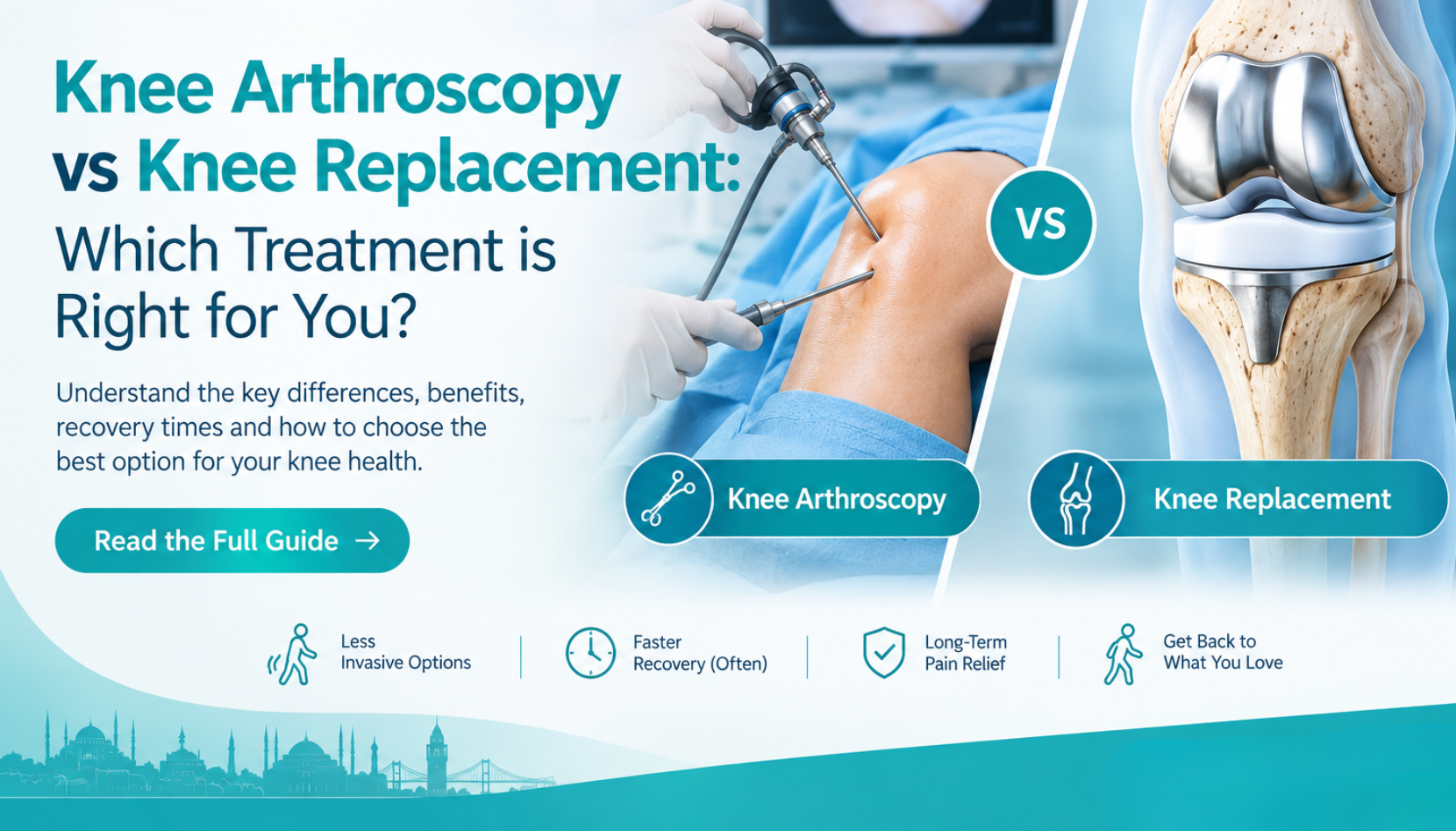
Persistent knee pain that limits walking, climbing stairs, or simply standing up after prolonged sitting can be both frustrating and confusing! Many patients arrive at their orthopedic consultation unsure whether knee arthroscopy or knee replacement surgery can address their condition, and the terminology often gets mixed up.
This blog clarifies both procedures, explains how surgeons determine candidacy, and outlines what recovery and cost genuinely involve, so you can approach your treatment decision with clinical clarity rather than guessworks.
Knee Arthroscopy and Knee Replacement: What’s the Real Difference?
| Factor | Knee Arthroscopy | Knee Replacement Surgery |
| Invasiveness | Minimally invasive: 2 to 4 small incisions are needed | Invasive, larger incision with implant placement |
| Primary Purpose | Diagnose and treat intra-articular issues | Replace worn or damaged joint surfaces |
| Anesthesia | Regional or general | Regional or general |
| Hospital Stay | Outpatient, same-day discharge | 1 to 4 days depending on protocol |
| Tissue Handled | Meniscus, ligaments, synovium | Femur, tibia, and patella articular surfaces |
| Implants Used | None | Metal and polyethylene components |
| Typical Candidates | Younger patients, mechanical symptoms | Mostly old-age patients facing advanced osteoarthritis or bone-on-bone damage |
| Durability | Months to a few years for degenerative cases | 20–25 years for modern implants |
Knee arthroscopy is a type of surgery that uses tiny incisions in the knee. An orthopedic surgeon inserts a thin camera called an arthroscope. This camera allows the surgeon to see inside the knee joint clearly. The surgeon uses this view to check for problems and treat them without knee damage.
The surgeon often uses tools through other tiny openings, called portals. These tools help repair torn tissue, remove loose cartilage, repair injured ligaments, or remove swollen lining tissue called synovium. The key point is that the knee’s normal structure stays mostly unchanged during this procedure.
On the other hand, knee replacement surgery is a much bigger operation. In this, the surgeon removes damaged bone and cartilage from the knee before putting them to parts. These parts are usually made from materials like medical-grade polyethylene and metal alloys. The goal is to rebuild the knee so it works better.
The main difference is that knee arthroscopy preserves the knee as much as possible. Knee replacement, on the other hand, changes the knee completely. That means each surgery is best for different knee problem types and different damage stages.
How Do You Know Which One Your Knee Actually Needs?
Determining the surgical pathway needs a careful and organized clinical evaluation. This process looks at where the symptoms are coming from, what the imaging shows, and how much the condition affects daily function.
Signs You May Need Knee Arthroscopy
a) Torn meniscus: You are experiencing a torn meniscus, a common knee condition.
b) ACL injury: A ligament injury while playing outdoor sports.
c) Loose bodies: Removal of bone or cartilage fragments.
d) Synovial inflammation: Persistent swelling that hasn’t improved with conservative care.
Signs You May Need Knee Replacement Surgery
a) Advanced osteoarthritis: Radiographic imaging indicates severe joint degeneration.
b) Cartilage erosion: Substantial wear and cushioning loss.
c) Bone-on-bone contact: Direct friction between bones leading to unbearable pain.
d) Persistent pain: Symptoms unresponsive to physiotherapy, medication, or injections.
The Role of Age and Activity Level
a) Younger patients: Young, active patients are the key candidates for joint-preserving arthroscopy.
b) Middle-aged patients: With degenerative changes, knee replacement offers more predictable outcomes.
c) Older patients: Implant longevity that aligns well with reduced long-term activity demands necessitates arthroscopy of the knees.
d) Active lifestyle: Arthroscopy suits those needing mechanical restoration while joint surfaces remain healthy.
Recovery, Cost, and What to Expect After Surgery
Recovery trajectories and financial considerations differ substantially between these two surgical procedures, and understanding both is crucial to setting realistic expectations before surgery.
Knee Arthroscopy Recovery
a) Same-day discharge is standard, with minimal hospitalisation required
b) Light activity typically resumes within days to a few weeks
c) Full functional recovery is generally achieved within six to eight weeks
d) Physical therapy focuses on regaining range of motion and strength early
Knee Replacement Surgery Recovery
a) Hospital stay usually spans one to four days depending on the surgical protocol
b) Supervised physiotherapy begins almost immediately to restore mobility
c) Most patients resume routine daily activities within three to six weeks
d) Complete recovery, including strength and endurance gains, continues for up to twelve months
When it comes to surgery expenses, patients often ask how much does a knee replacement costs. The answer largely depends on type, hospital infrastructure, surgeon expertise and geographic location.
Knee replacement surgery generally has a higher upfront cost than arthroscopy. The higher cost comes from materials, operating theatre time and longer hospitalisation. Arthroscopy, on the other hand, costs less for each session but may need repeat procedures in some cases.
Patients evaluating both options should ask for a cost breakdown that includes surgical fees, implant charges, anesthesia and post‑operative rehabilitation before finalising their treatment plan.
Conclusion
Choosing between knee arthroscopy and knee replacement surgery ultimately comes down to the underlying diagnosis, joint imaging findings, age, activity level, and cartilage damage severity, and this decision should always follow a thorough orthopedic evaluation.
For patients seeking high-quality, affordable surgical care, Prospero Medical facilitates access to accredited international hospitals and experienced orthopedic teams, offering a trusted medical tourism pathway for both procedures, complete with coordinated consultation, transparent pricing, travel logistics, and structured aftercare support.
Tap on this LINK to schedule an online consultation!
FAQs
1. Can Knee Arthroscopy Convert to Knee Replacement During the Same Surgery?
No, both surgeries are distinct procedures performed with different instruments and objectives, and a surgeon will not switch mid-operation without prior planning and consent.
2. Is Knee Replacement Surgery Painful During the Procedure Itself?
No, general or regional anesthesia is administered to patients during the surgery. Hence, they feel no pain, though post-operative discomfort is common, which can be effectively managed with prescribed medication.
3. Can Both Knees be Operated on at the Same Time?
Bilateral procedures may be possible in selected candidates (typically younger adults), though staged surgery is often preferred to reduce the combined recovery burden.
4. Does Knee Replacement Surgery Set Off Airport Metal Detectors?
Yes, prosthetic implants often trigger metal detectors, so it is advisable to carry a surgical implant card with you while travelling.
5. How Long Do Modern Knee Replacement Surgery Implants Typically Last?
Most modern implants last between twenty and twenty-five years, depending on activity level, weight, and adherence to post-surgical care.




 Request A Call